

Lady danger
On the fascination with true crime content and the recent flurry of crime novels featuring female protagonists

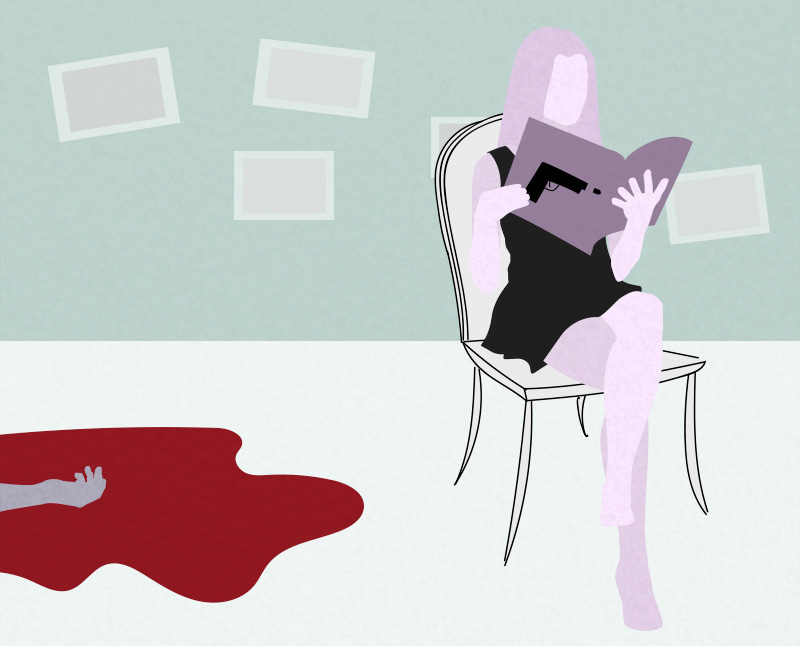
Image courtesy of Shannon Sands.
As I write this, an ITV true crime documentary is playing in the background. I listened to a true crime podcast on my way home from the nursery drop-off. I read the latest developments in the discovery of human remains in Bristol on BBC News during my tea break. If there’s a new true crime documentary series due to come out, you can bet your machete I’ll be streaming it straight away.
I distinctly remember my induction to the world of crime content. I was around 11 or 12 and I became obsessed with James Patterson books, in particular, the Alex Cross series (probably not the most age-appropriate reading material but I was a mature child with a voracious reading appetite which could no longer be sated by Jaqueline Wilson). This violent and vivid world of murder, stalking, kidnap and obsession started off a lifelong love of the crime and thriller genre which, 20-odd years later, has become a key personality trait.
I’ve always been interested in the macabre and morbid. I remember going through a phase of being fascinated by Victorian post-mortem photography, also known as ‘memento mori’. Creepypasta helped to while away many hours of boredom during school and college. Cut to today and I can reasonably guess that around 30% of the content I consume, at least, is true crime focussed. But am I an anomaly, or are there more weirdos out there like me?
According to data from Vivint, there are many of us. In a 2023 survey, millennials spend an average of 3.8 hours a week consuming grime, while Gen Z spend even more time, at 4.6 hours. Unsolved mysteries came out as the most popular sub-genre, followed by series such as Tiger King and Making a Murderer. It’s not a new phenomenon either. Interest in true crime dates as far back as the Middle Ages with so-called ‘murder ballads’, which were sung to recite news about local homicides among the illiterate masses. Fast-forward to the 16th century and as more people got to grips with the written word, broadsheets and pamphlets depicting crimes became popular. Then in the era of Sherlock Holmes, the public became intrigued by the word of investigators. True crime as we now know it is said to have begun in 1965 with the publication of the first modern true crime book, Truman Capote’s In Cold Blood. Unsurprisingly for the time the novel, which contained gruesome and graphic content, was heavily criticised, and even banned for a short time. Lord knows what those naysayers would make of Netflix…
Cut to today and you can’t scroll through a streaming service without coming across a true crime series. Likewise, the podcast genre amasses millions of subscribers and listeners every day, 73% of which are women. There are a lot of interesting gendered differences between true crime content consumption which I won’t go into here, but there are lots of intriguing statistics in this Social Science Space article.
So what is the fascination? According to Dean Fido, Lecturer in Psychology at the University of Derby Online Learning, it’s all about the puzzle presented:
“True crime is very different from the typical shows you normally have on in the background. They are the sort of stories you need to put your phone down and actually pay attention to. It’s a big puzzle and we don’t want to be left without a vital piece of information because we were checking social media.
“As humans, we are always looking for something new and novel. Whether it’s good or bad, we need something that creates an element of excitement. When we mix this desire with insight and solving a puzzle, it can give us a short, sharp shock of adrenaline, but in a relatively safe environment.”
Another theory is that for some, learning the details of these most heinous of crimes gives them a sense of power over their own safety. In that same Vivint study referenced earlier, 54% of people surveyed claimed that consuming true crime content helped them to prepare for unsafe situations, while 1 in 3 of people who had themselves been victims of crime said that it helped them react better to the incident. Knowledge is power and in this instance, learning the details behind true crime events makes consumers feel more prepared for the worst.
One thing I’ve noticed recently in the wider crime genre is an increase in the number of books which feature female killers as the main character. From Bella Mackie’s How to Kill Your Family, and Katy Brent’s How to Kill Men and Get Away with it, to the hugely popular My Sister: The Serial Killer by Oyinkan Braithwaite, there’s been a recent rise in stories featuring women killers at their heart. And why is that?
Personally, I think that women are sick of seeing themselves portrayed as the victims of crime. If I ask you to name three notable serial killers right now, chances are they’ll be men. There are only a handful of prolific female serial killers, and they’ve been portrayed by the media as ugly, flawed, deeply disturbed individuals (Aileen Wuornos, for instance, was famously portrayed by Charlize Theron in the 2003 film Monster, need I say more?) At the opposite end of the spectrum, male serial killers are romanticised and portrayed as heart-throbs - the casting of Zac Efron as Ted Bundy in 2019’s Extremely Wicked, Shockingly Evil and Vile is a prime example of how men who kill are still, for the most part, desirable figures.
But these new female leads aren’t physically abhorrent, or mentally unhinged. They’re confident, sexy, intelligent women who have taken control of their circumstances, which just so happens to involve murder. How to Kill Your Family’s antihero, Grace Bernard, is young, driven, articulate and ambitious; she just so happens to also be on a violent killing spree. How to Kill Men and Get Away With It’s protagonist, Kitty Collins, is a wealthy Instagram influencer who just so happens to enjoy enacting revenge on men who have committed gross and lurid acts against women. She is the exact opposite to how the media have tended to portray women killers in the past. She is wealthy, intelligent and successful, not a poorly educated red-neck with crooked teeth.
These women, despite the slight character flaw of committing murder, are aspirational figures. And they put women in the driving seat of crime, counteracting the stereotype of the helpless victim. They allow us, the reader, to play out our deepest, darkest fantasies. Who hasn’t imagined putting a knife to the throat of that guy in the nightclub who groped your arse while you were dancing? Or being able to silently execute the hooded figure following you home late at night through a dark park? As crime author Francesca Dorricott says:
“Most women have been taught to restrain their actions, their thoughts, and sometimes even their imaginations. We can witness a solution to a stalking charge without ever being in danger ourselves, we can see a bad person put behind bars and feel relieved, we can explore our own behaviour and thoughts without being judged.”